
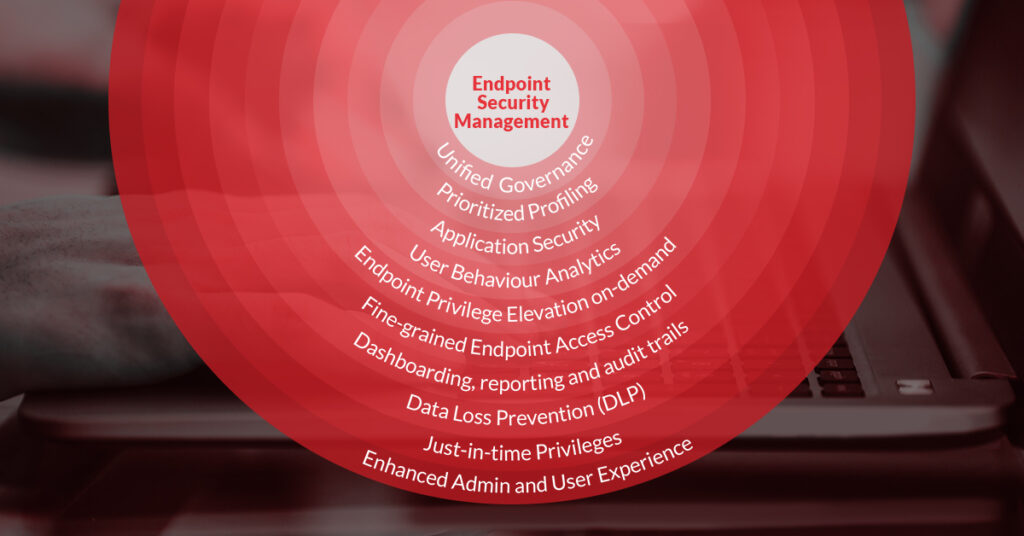
Best Practices for Endpoint Security and Management
Enterprise Risk Management teams faced a stiff challenge to ensure business continuity following the disruptions caused by the pandemic. Moreover, Information Security vulnerability increased as businesses altered their IT operations and administrative tasks to adjust to the new normal.
Among many challenges, remote access posed all sorts of risks associated with data security and privacy. And poor management and monitoring of endpoints increased the threats of data misuse and abuse.
Against the backdrop for increasing number of endpoints and remote access use-case instances along with growing BYOD/BYOPC culture, endpoint security demands utmost planning and preparedness.
Therefore, Endpoint Security and Management has become a pivotal point in the overall enterprise access control framework.
Endpoint Access just like Privileged Access or Identity Governance and Management demands careful organization around people, roles and responsibilities.
The endpoint security vulnerability could be mitigated significantly when organizations define end-user access policies, adopt a unified endpoint governance framework, implements endpoint privileges on-demand among other best practices such as User Behavior Analytics.
IT Risk Management teams would find merit in implementing the best practices in Endpoint Security and Management as it significantly reduces endpoint attack surface.
In this whitepaper, ARCON discusses 10 time-tested best practices to mitigate threats arising from unmonitored and unmanaged endpoints.
Download White Paper
Please share your details to download Best Practices for Endpoint Security and Management.
By filling out this form, you agree to our Privacy Policy.
Related White Papers
ARCON Secrets Management
The whitepaper by KuppingerCole explores the growing challenge of managing machine identities—which now outnumber human users—as enterprises adopt cloud, microservices, CI/CD pipelines, and zero-trust architectures. It highlights how credential sprawl, hardcoded secrets, and inadequate rotation create systemic security risks. The document outlines compliance pressures across global and regional standards, emphasizing auditability, lifecycle governance, and encryption requirements. ARCON Secrets Management is presented as a cost-effective, enterprise-grade solution integrated with ARCON’s broader PAM platform. It provides centralized vaulting, automated rotation, Kubernetes sidecar authentication, and integrations across DevOps, cloud, RPA, and security tools. With AES-256 encryption and zero-trust analytics, ARCON targets regulated industries in APAC and the Middle East. The paper concludes with guidance for evaluating solutions—prioritizing technical fit, integration depth, compliance evidence, vendor stability, and real-world deployment complexity. Read the Whitepaper

Machine Identities and Inherent Risks: Protecting Digital Environments and Enabling Automations, at Scale
In today’s overly complex digitalized world, machine identities are increasing at a very rapid pace. It is believed that for every human identity created in a typical large to midsized enterprise environment, there are forty to sixty times more machine identities. As there are challenges arising from machine identities, managing non-human privileged accounts will require a concerted effort in terms of security and compliance. Non-human privileged accounts will have to be controlled and monitored just like human privileged accounts. Just like human privileged accounts, security leaders will have to implement processes and procedures to manage devices, services and workloads, ensuring security shield around non-human privileged accounts. Read this white paper to know the key capabilities of ARCON’s Digital Vault that manages, controls and secures machine identities in a humungous IT environment.

Identity Governance and Identity Threat Detection and Response: The Two Key Components to Building a Robust Identity Stack
Effective identity governance (IG) is becoming increasingly crucial in today’s complex IT ecosystems, serving as a cornerstone for establishing an identity-first security strategy. Modern organizations operate in highly distributed environments, with users and assets (cloud/on-Prem) multiplying exponentially across diverse cloud platforms and hybrid data centers. At the same time, IG plays a crucial role in strengthening Identity Threat Detection and Response (ITDR) technology by enforcing policies, managing access controls, and ensuring compliance across an organization’s identity infrastructure. While identity governance builds a perimeter-centric security around every privileged identity, it is highly imperative that any task/ action happening outside the perimeter or the pre-defined roles, must be identified, addressed and mitigated. And Identity Threat Detection and Response (ITDR) is the preemptive component to support it. Read this white paper to know why ARCON | Privileged Access Management (PAM) is a convergence point for IGA and ITDR by enforcing identity security while detecting and mitigating identity-based threats simultaneously.
Stay ahead of the identity security curve.
Get the latest insights, research, security trends, compliance guidance and identity security intelligence delivered directly to your inbox.